Warning: Trying to access array offset on value of type null in /htdocs/wp-content/plugins/unyson/framework/helpers/general.php on line 1275
Warning: foreach() argument must be of type array|object, null given in /htdocs/wp-content/plugins/unyson/framework/helpers/general.php on line 1275 Archives des News - BFM Ltd
Cal-Maine Foods — Cal-Maine shares shed 15% after reporting earnings that fell short of Wall Street’s expectations even as the egg producer reported record sales. The company said the avian flu outbreak limited supply and pushed prices up.
Lockheed Martin — The defense contractor’s stock rose nearly 1% following news that its Sikorsky unit is contesting a U.S. Army helicopter contract awarded to Textron. It said proposals for the $1.3 billion contract were not evaluated fairly. Textron shares were last up 1.9%.
Tesla — Tesla shares gained more than 7% after selling off during the previous sessions and 37% this month. The stock’s headed for one of its worst months, quarters and years ever.
Apple — The iPhone maker’s stock rose more than 3% after hitting its lowest level since June 2021 earlier in the week.
General Electric — Shares rose 1.7% amid news that General Electric’s health-care spinoff will join the S&P 500 when it starts trading separately on Jan. 4. GE Healthcare will replace Vornado Realty Trust, set to join the S&P MidCap 400.
ImmunoGen — Shares added 6.2% after the biotechnology company announced CFO Susan Altschuller would not return from her time off. Renee Lentini, the vice president and chief accounting officer, was named interim CFO. The stock initially dropped in premarket trading.
Following a record-smashing tech IPO year in 2021 that featured the debuts of electric car maker Rivian, restaurant software company Toast, cloud software vendors GitLab and HashiCorp and stock-trading app Robinhood, 2022 has been a complete dud.
The only notable tech offering in the U.S. this year was Intel’s spinoff of Mobileye, a 23-year-old company that makes technology for self-driving cars and was publicly traded until its acquisition in 2017. Mobileye raised just under $1 billion, and no other U.S. tech IPO pulled in even $100 million, according to FactSet.
In 2021, by contrast, there were at least 10 tech IPOs in the U.S. that raised $1 billion or more, and that doesn’t account for the direct listings of Roblox, Coinbase and Squarespace, which were so well-capitalized they didn’t need to bring in outside cash.
The narrative completely flipped when the calendar turned, with investors bailing on risk and the promise of future growth, in favor of profitable businesses with balance sheets deemed strong enough to weather an economic downturn and sustained higher interest rates. Pre-IPO companies altered their plans after seeing their public market peers plunge by 50%, 60%, and in some cases, more than 90% from last year’s highs.
In total, IPO deal proceeds plummeted 94% in 2022 — from $155.8 billion to $8.6 billion — according to Ernst & Young’s IPO report published in mid-December. As of the report’s publication date, the fourth quarter was on pace to be the weakest of the year.
With the Nasdaq Composite headed for its steepest annual slump since 2008 and its first back-to-back years underperforming the S&P 500 since 2006-2007, tech investors are looking for signs of a bottom.
But David Trainer, CEO of stock research firm New Constructs, says investors first need to get a grip on reality and get back to valuing emerging tech companies based on fundamentals and not far-out promises.
As tech IPOs were flying in 2020 and 2021, Trainer was waving the warning flag, putting out detailed reports on software, e-commerce and tech-adjacent companies that were taking their sky-high private market valuations to the public markets. Trainer’s calls appeared comically bearish when the market was soaring, but many of his picks look prescient today, with Robinhood, Rivian and Sweetgreen each down at least 85% from their highs last year.
“Until we see a persistent return to intelligent capital allocation as the primary driver of investment decisions, I think the IPO market will struggle,” Trainer said in an email. “Once investors focus on fundamentals again, I think the markets can get back to doing what they are supposed to do: support intelligent allocation of capital.”
Lynn Martin, president of the New York Stock Exchange, told CNBC’s “Squawk on the Street” last week that she’s “optimistic about 2023″ because the “backlog has never been stronger,” and that activity will pick up once volatility in the market starts to dissipate.
Hangover from last year’s ‘binge drinking’
For companies in the pipeline, the problem isn’t as simple as overcoming a bear market and volatility. They also have to acknowledge that the valuations they achieved from private investors don’t reflect the change in public market sentiment.
Companies that were funded over the past few years did so at the tail end of an extended bull run, during which interest rates were at historic lows and tech was driving major changes in the economy. Facebook’smega IPO in 2012 and the millionaires minted by the likes of Uber, Airbnb, Twilio and Snowflake recycled money back into the tech ecosystem.
Venture capital firms, meanwhile, raised ever larger funds, competing with a new crop of hedge funds and private equity firms that were pumping so much money into tech that many companies were opting to stay private for longer than they otherwise would.
Money was plentiful. Financial discipline was not.
In 2021, VC firms raised $131 billion, topping $100 billion for the first time and marking a second straight year over $80 billion, according to the National Venture Capital Association. The average post-money valuation for VC deals across all stages rose to $360 million in 2021 from about $200 million the prior year, the NVCA said.
Those valuations are in the rearview mirror, and any companies who raised during that period will have to face up to reality before they go public.
Some high-valued late-stage startups have already taken their lumps, though they may not be dramatic enough.
Stripe cut its internal valuation by 28% in July, from $95 billion to $74 billion, the Wall Street Journal reported, citing people familiar with the matter. Checkout.com slashed its valuation this month to $11 billion from $40 billion, according to the Financial Times. Instacart has taken multiple hits, reducing its valuation from $39 billion to $24 billion in May, then to $15 billion in July, and finally to $10 billion this week, according to The Information.
Klarna, a provider of buy now, pay later technology, suffered perhaps the steepest drop in value among big-name startups. The Stockholm-based company raised financing at a $6.7 billion valuation this year, an 85% discount to its prior valuation of $46 billion.
“There was a hangover from all the binge drinking in 2021,” said Don Butler, managing director at Thomvest Ventures.
Butler doesn’t expect the IPO market to get appreciably better in 2023. Ongoing rate hikes by the Federal Reserve are looking more likely to tip the economy into recession, and there are no signs yet that investors are excited to take on risk.
“What I’m seeing is that companies are looking at weakening b-to-b demand and consumer demand,” Butler said. “That’s going to make for a difficult ’23 as well.”
Butler also thinks that Silicon Valley has to adapt to a shift away from the growth-first mindset before the IPO market picks up again. That not only means getting more efficient with capital, showing a near-term path to profitability, and reining in hiring expectations, but also requires making structural changes to the way organizations run.
For example, startups have poured money into human resources in recent years to handle the influx in people and the aggressive recruiting across the industry. There’s far less need for those jobs during a hiring freeze, and in a market that’s seen 150,000 job cuts in 2022, according to tracking website Layoffs.fyi.
Butler said he expects this “cultural reset” to take a couple more quarters and said, “that makes me remain pessimistic on the IPO market.”
Cash is king
One high-priced private company that has maintained its valuation is Databricks, whose software helps customers store and clean up data so employees can analyze and use it.
Databricks raised $1.6 billion at a $38 billion valuation in August of 2021, near the market’s peak. As of mid-2021, the company was on pace to generate $1 billion in annual revenue, growing 75% year over year. It was on everybody’s list for top IPO candidates coming into the year.
Databricks CEO Ali Ghodsi isn’t talking about an IPO now, but at least he’s not expressing concerns about his company’s capital position. In fact, he says being private today plays to his advantage.
“If you’re public, the only thing that matters is cash flow right now and what are you doing every day to increase your cash flow,” Ghodsi told CNBC. “I think it’s short-sighted, but I understand that’s what markets demand right now. We’re not public, so we don’t have to live by that.”
Ghodsi said Databricks has “a lot of cash,” and even in a “sky is falling” scenario like the dot-com crash of 2000, the company “would be fully financed in a very healthy way without having to raise any money.”
Databricks has avoided layoffs and Ghodsi said the company plans to continue to hire to take advantage of readily available talent.
“We’re in a unique position, because we’re extremely well-capitalized and we’re private,” Ghodsi said. “We’re going to take an asymmetric strategy with respect to investments.”
That approach may make Databricks an attractive IPO candidate at some point in the future, but the valuation question remains a lingering concern.
Snowflake, the closest public market comparison to Databricks, has lost almost two-thirds of its value since peaking in November 2021. Snowflake’s IPO in 2020 was the largest ever in the U.S. for a software company, raising almost $3.9 billion.
Snowflake’s growth has remained robust. Revenue in the latest quarter soared 67%, beating estimates. Adjusted profit was also better than expectations, and the company said it generated $65 million in free cash flow in the quarter.
Still, the stock is down almost 20% in the fourth quarter.
“The sentiment in the market is a little stressed out,” Snowflake CEO Frank Slootman told CNBC’s Jim Cramer after the earnings report on Nov. 30. “People react very strongly. That’s understood, but we live in the real world, and we just go one day at a time, one quarter at a time.”
Generac — The equipment maker gained 5.6% following Janney Montgomery Scott’s initiation at buy. The firm gave the stock a price target of $160, which implies an upside of 75.5% from where it closed Tuesday.
Energy stocks – A slate of energy companies slipped alongside falling prices for oil and natural gas. EQT dropped 7.8%, APA shed 5.2% and Coterra lost 4.7%. Those three names were among the biggest losers in the S&P 500 in midday trading.
Maxeon — Shares slid 9.3% after the solar company announced Bill Mulligan would be the new CEO. He previously was a chief operating officer at Sila Nanotechnologies.
Apple — Shares of the technology giant slid 3.1%. The stock has dropped the last three days, touching a fresh 52-week low on Wednesday.
IDEAYA Biosciences — IDEAYA added 5.7% following an initiation at overweight from Capital One Securities. The firm gave the stock a price target of $29, which presents an upside of 75.4% over where it closed Tuesday.
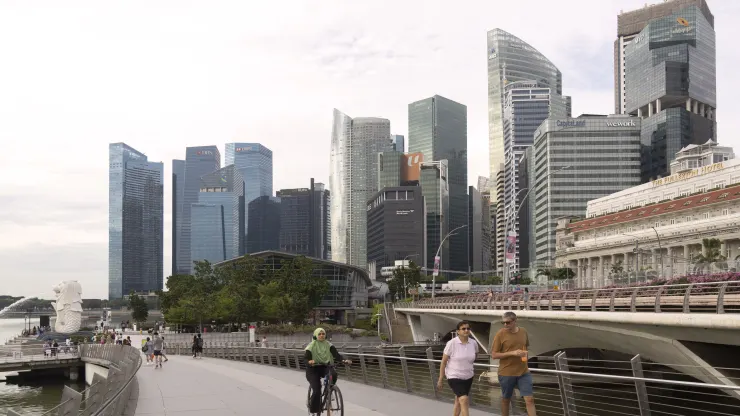
Come Jan. 1, Singapore will raise its goods and services tax, otherwise known as the GST, from 7% to 8%. It’s the first of two scheduled hikes of the GST, with the second slated to take place in January 2024, when the GST will be raised from 8% to 9%.
The GST is a consumption tax imposed on nearly all goods and services in Singapore. Starting Jan. 1, 2023, GST will be imposed on imported low-value goods valued up to S$400. Currently, only imported goods valued above S$400 are subjected to the GST. With the change, all goods and services imported into Singapore, including imported goods purchased online, will be subject to the tax.
Businesses based in Singapore with an annual turnover exceeding S$1 million (US$742,000) are required to register for GST and charge GST on all taxable goods at the prevailing rate.
Singapore’s Parliament passed the bill to amend the GST in November, despite members of parliament from Singapore’s opposition parties coming out against the hike, citing poor timing amid inflationary pressures.
Inflation rate in Singapore hit a 14-year high of 7.5% in August. Inflation has eased slightly in recent months, with November’s annual inflation rate at 6.7%, but that’s significantly higher than the 2% inflation that the country’s central bank recommends for overall price stability.
Who will be affected most?
Economists who spoke to CNBC held conflicting views on whether the tax hike will hit the nation’s lowest earners harder than others.
Low-income people tend to save less and consume more, said Antonio Fatas, professor of economics at INSEAD. “Given that this is a tax on consumption, the immediate effect might be felt more by them,” he said.
Singapore recently made a S$1.4 billion increase to a $6.6 billion fund designed to cushion the impact of the GST hikes. Payouts from the Assurance Package, which now stands at S$8 billion, will be dispersed over five years starting December 2022. Up to 2.9 million adult Singaporeans are slated to receive cash payouts that vary depending on their income and property ownership status.
The Assurance Package is designed to cover at least five years of additional GST expenses for most Singaporean households, and about 10 years for lower-income households, according to Singapore’s Deputy Prime Minister and Minister for Finance Lawrence Wong.
Euston Quah, head of economics at the Nanyang Technological University, said those offsets will spare low-income households from the tax hike’s effects.
“The lower-income group will not be affected, as there are offsets, rebates, and sufficient transfers for them,” Quah said.
Upper-income people will not be impacted much, Quah said, since they have the means to carry on with their lifestyles.
Middle-income Singaporeans could be the most affected by GST hikes, since they neither qualify for financial aid and rebates nor are they necessarily able to afford higher prices, he said.
Business sectors and price-sensitivity
Some business sectors may be more affected than others, depending on the “demand elasticities” of the goods and services they provide, Quah said. Elasticity measures how sensitive demand for a product is to changes in price.
Businesses selling products whose demand is sensitive to changes in price, such as luxury brands and high-end restaurants, will be more affected by the hike than businesses such as supermarkets that sell basic necessities, Quah said.
Ride-hailing services in Singapore are split in their responses to the GST hike.
Grab told CNBC that its drivers will pay the 1% GST increase to tax authorities, but Grab will continue to absorb the existing 7% GST. The company said it’s offering six months of “rebate” on the 1% GST to drivers who are most affected.
Ride-hailing firm ComfortDelGro said it will extend its daily rental waiver of 15% until March 31, 2023 to help its drivers cope with the rising cost of living. Its commission fees will remain unchanged.
Another ride-hailing service, Ryde, did not immediately respond to a request for comment, but the company told The Straits Times that commission fees will remain the same.
Most businesses should not be significantly affected by the hike, but charities and non-profit organizations may be, because they can’t claim the GST incurred for free non-business activities, such as free medical services, said Ajay Kumar Sanganeria, partner at accounting firm KPMG.
A spike in purchases of big-ticket items is expected prior to the implementation of each GST hike, he added. Customers make purchases such as furniture and cars ahead of new taxes to avoid paying the added cost, Sanganeria said.
Why now?
There is “never a good time” for a rise in GST rates, said Sanganeria.
“Even before the pandemic, it was pertinent for Singapore to increase its tax revenue to fund social spending, given Singapore’s aging population and the rising healthcare and infrastructure costs,” he said. The pandemic has increased that healthcare expenditure.
“It is not difficult to realize that Singapore needs to find more fiscally sustainable ways to fund its social, environmental and healthcare needs.”
The number of citizens aged 80 and above has increased by over 70% since 2012, according to this year’s population report. By 2030, around one in four of Singaporeans will be 65 or older, the report says.
According to Singapore’s Ministry of Finance, healthcare spending is expected to increase from S$11.3 billion today to S$27 billion by 2030.
Singapore is one of the fastest-aging countries around the world due to low fertility rates and longer life expectancies.
How Singapore compares with other countries
After the two-step rate hike to 9% from Jan. 1 2024, Singapore’s GST rate will remain one of the lowest in Asia-Pacific, said Chew Boon Choo, partner of Indirect Tax at consulting firm Ernst & Young Solutions.
As of January of this year, most Asia-Pacific countries had a goods and services tax of more than 7%.
China’s goods and services tax is 13%. The Philippines and Vietnam have a goods and services tax rate of 12% and 10%, respectively.
Taiwan has the region’s lowest goods and services tax at 5%, according to EY.
Other countries in the region have raised their goods and services taxes recently. Indonesia, which raised its rate from 10% to 11% from April of this year, plans to go to 12% by Jan. 1 2025. Japan’s consumption tax rate is now 10%, up from 8% before October 2019.
In August 2021, the Thai Cabinet approved the extension of the reduced Value Added Tax (VAT) rate of 7% for another two years in light of economic pressures caused by the Covid-19 pandemic. The VAT rate will revert to 10% late next year if there is no further extension.